
Document Storage Retrieval: Why Organization Beats Space

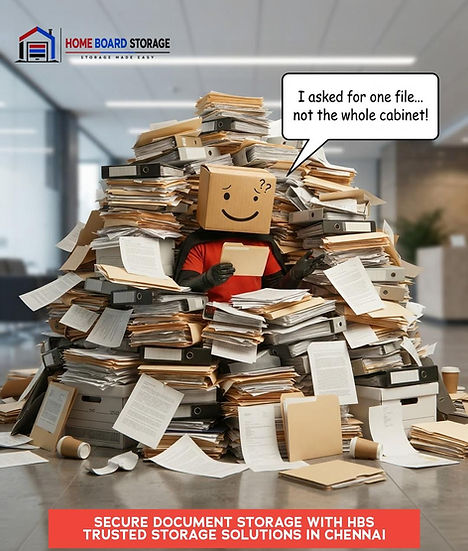
Every office has had this moment: someone asks for a single old invoice, and what comes back is an entire box - or worse, an entire cabinet - of unrelated paperwork to sort through. Document storage retrieval problems like this rarely come from a lack of storage space; they come from a lack of organization within that space. This guide covers how properly indexed, well-organized document storage across Chennai, Kattupakkam, and Bangalore turns "find that one file" from an hours-long search into a five-minute task.
Quick Answer
Document storage retrieval works well only when storage is organized by category, date, and a searchable inventory list - not simply by cramming boxes onto shelves. A facility with plenty of secure space but no indexing system will still leave you digging through irrelevant files every time you need something specific, so organization matters just as much as security when choosing a document storage provider.
Table of Contents
Key Takeaways
What Makes Document Retrieval Actually Fast?
Why "More Storage Space" Doesn't Solve Retrieval Problems
Who Struggles Most with Document Retrieval?
When Poor Organization Becomes a Real Business Problem
Where to Store Documents So They Stay Findable
How to Set Up an Indexing System That Actually Works
Organized Storage vs. Piled-Up Storage
Pros and Cons of Investing in Document Organization
FAQs
Conclusion
Key Takeaways
Document storage retrieval depends on organization and indexing, not just on having enough secure space.
A category-and-date labeling system is the single most effective way to make retrieval fast and predictable.
Businesses without a searchable inventory list often waste hours locating documents that should take minutes to find.
A good document storage provider maintains records of where each file category is physically located.
Reviewing and updating your indexing system periodically prevents it from becoming outdated as new documents are added.
What Makes Document Retrieval Actually Fast?
Fast retrieval comes from a documented, searchable system -not luck, and not simply having a large enough storage unit. Document storage retrieval refers to the process of locating and accessing specific stored records quickly, which depends primarily on how well documents were categorized, labeled, and logged at the time they were stored.
A facility can have excellent security and climate control and still fail at retrieval if boxes are stacked without any labeling system connecting them to an inventory list.
Why "More Storage Space" Doesn't Solve Retrieval Problems
It's a common assumption that document chaos is a space problem - that a bigger room or more shelving would fix the mess. In reality, unindexed documents remain just as hard to find in a large, spacious archive as in a cramped one; the problem isn't the amount of space, it's the absence of a system connecting a specific file to a specific, known location.
Expert Insight: "I've seen businesses with acres of storage space still spend hours looking for a single contract, simply because nothing was logged when it went in. Space solves clutter. Only an index solves retrieval." - Storage and relocation specialist with 12+ years of experience helping households and businesses in Chennai and Bangalore find secure storage solutions.
Who Struggles Most with Document Retrieval?
Accounting and finance teams needing quick access to specific invoices or tax records during audits
Legal practices retrieving individual case files from years of archived paperwork
HR departments locating a specific employee's record among thousands of files
Growing businesses that started with a simple filing cabinet and have since outgrown any informal system
Anyone who inherited an existing archive without documentation of how it was originally organized
Each of these groups tends to discover the problem the same way - not gradually, but suddenly, at the exact moment a specific document is needed urgently and can't be found quickly. That mismatch between "we have plenty of storage" and "we can't actually find anything" is almost always a symptom of missing organization, not insufficient space.
When Poor Organization Becomes a Real Business Problem
Disorganized document storage typically stays a minor annoyance until a specific moment forces the issue - an audit, a legal request, or a customer dispute requiring a particular record on short notice. At that point, what would have taken minutes with a proper index can turn into hours or days of searching, sometimes under real time pressure with real consequences for missing a deadline.
This is often the point at which businesses finally invest in proper indexing, but retrofitting an existing disorganized archive is considerably more work than building good habits from the start. Establishing a labeling and inventory system at the very first box, rather than waiting until a crisis forces the issue, saves significant time and stress later.
Where to Store Documents So They Stay Findable
For a broader look at secure document storage options across the city, see our full guide to storage space in Chennai. West Chennai businesses near Kattupakkam can access local document storage branches, which also matters for retrieval speed, since a nearby facility means faster turnaround when a specific file is needed urgently.
How to Set Up an Indexing System That Actually Works
Label boxes by category first, then by date range - category should be the primary sort, since most retrieval requests start with "find the contracts" or "find the invoices," not a specific date
Keep a master inventory list cross-referencing box labels to their physical shelf location
Separate frequently accessed documents from long-term archives, so routine requests don't require digging through years-old records
Update the index immediately whenever new documents are added, rather than batching updates for later
Confirm your provider maintains their own parallel record, so retrieval requests can be verified from both sides
If your document storage needs are tied to an office move or reorganization, coordinating with experienced packers and movers in Chennai at the same time ensures documents are logged accurately from day one, rather than arriving at a new storage facility already disorganized.
Organized Storage vs. Piled-Up Storage
Piled-up storage - boxes stacked without a labeling system - costs nothing extra to set up but turns every retrieval request into a search operation, often requiring someone to physically open and check multiple boxes before finding the right one. Organized storage requires an upfront investment of time to label and index properly, but turns retrieval into a quick, predictable lookup, since the exact location of any given document is already known.
For any business retrieving documents more than a handful of times a year, the upfront organization cost pays for itself many times over in saved staff hours. Even a modest investment - a single afternoon spent properly labeling and logging an existing archive - can transform future retrieval from a dreaded task into a routine, five-minute lookup.
Pros and Cons of Investing in Document Organization
Pros:
Turns retrieval from a search into a quick, predictable lookup
Reduces staff time spent hunting for specific records
Makes audits and legal requests far less stressful
Scales cleanly as new documents are added, if the system is maintained
Cons:
Requires upfront time investment to label and index properly
Needs ongoing discipline to keep the index updated as documents are added or removed
May require working with a provider that supports proper indexing, not just raw storage space
Businesses evaluating organized document storage options in Bangalore should also check our dedicated guide to storage services in Bangalore for local providers who support proper indexing systems.
FAQs
Why is document retrieval slow even with enough storage space?
Retrieval speed depends on organization and indexing, not storage space - a large archive without labeling is just as hard to search as a small one.
What's the best way to organize documents for fast retrieval?
Label by category first, then date range, and maintain a master inventory list cross-referencing labels to physical locations.
How often should a document indexing system be updated?
Immediately whenever new documents are added, rather than batching updates, to avoid the index becoming outdated.
Can a storage provider help with document organization?
Reputable providers maintain their own parallel inventory records and can support category-based organization, so ask specifically about this before booking.
Is document organization worth the upfront time investment?
Yes, for any business retrieving documents regularly, since the time saved on each retrieval typically outweighs the initial setup effort many times over.
Conclusion
Fast document storage retrieval comes down to organization, not just square footage - a well-indexed system turns "find that one file" back into a five-minute task instead of an afternoon-long search. Whether you're setting up storage for the first time or fixing an existing pile of unlabeled boxes, investing in a proper category-and-inventory system pays off every single time a document needs to be found again.
Get a free quote for storage space in Chennai, Kattupakkam, or Bangalore - call +91 9080 5354 00 or book a pickup today.


Comments